

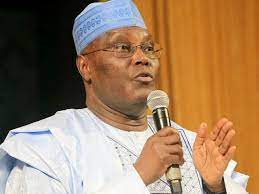
 Former Vice President and presidential candidate of the African Democratic Congress, Atiku Abubakar, on Tuesday accused President Bola Tinubu of either being complicit in or unaware of alleged irregularities in the implementation of the 2026 budget, following claims that billions of naira meant for Almajiri education agency were earmarked for road construction projects.
Atiku said the latest revelations, coupled with allegations surrounding the controversial Presidential Foreign Intervention Promotion Council, pointed to what he described as a pattern of budget manipulation and abuse of public funds in the incumbent government.
In a statement issued by his Senior Special Assistant on Public Communication, Phrank Shaibu, the former vice president said attempts by the presidency to distance the Chief of Staff to the President, Femi Gbajabiamila, from the PFIPC controversy had only deepened public suspicion.
Atiku was reacting to a recent Daily Trust special report which showed that the National Commission for Almajiri and Out-of-School Children Education was allocated billions of naira for road projects unrelated to its statutory responsibilities.
“The question that naturally arises is this: Since when did the National Commission for Almajiri and Out-of-School Children Education become a road construction agency?” Atiku asked.
He argued that at a time when millions of Nigerian children remain out of school, channelling funds meant for an education-focused agency into road projects represented “not merely a distortion of priorities but a cruel betrayal of the very children the Commission was created to serve.”
Atiku alleged that the development reflected “the now familiar tactic of hiding questionable projects in backwater agencies where public scrutiny is minimal and where funds can be more easily diverted.
“This is the height of irresponsibility. It is the height of impunity. Indeed, it is the height of evil,” he said.
The former vice president also linked the budget controversy to allegations made by Prince Adeniyi Adeyemi, who has claimed that senior government officials demanded billions of naira from him in connection with the proposed PFIPC.
According to Atiku, the presidency had failed to adequately address the allegations, insisting that mere denials were insufficient.
“If Prince Adeyemi is indeed the fraudster that government spokespersons now portray him to be, why has he not been arraigned before a competent court of law since he was first invited for questioning late last year?” he queried.
He also questioned why Adeyemi was allegedly still operating from the Federal Secretariat and how he was reportedly able to pay a courtesy visit to the leadership of the Economic and Financial Crimes Commission despite being under investigation.
Atiku further argued that Tinubu could not dissociate himself from the issues raised.
“The budget is his budget. The Appropriation Act bears his signature. The agencies involved operate under his administration,” he said.
“If billions of naira can be hidden under agencies with no legal mandate to execute such projects, then either the President approved these distortions or he was completely unaware of what was happening under his watch.
“The first possibility would amount to complicity. The second would amount to an admission of an absentee presidency where consequential decisions are being taken without the knowledge or supervision of the President.”
The ADC chieftain called on the National Assembly to explain how the alleged irregular appropriations passed legislative scrutiny.
“The National Assembly must also explain how these bizarre appropriations escaped legislative scrutiny. Parliament was established as the watchdog of the public purse and not as an assembly whose principal function is to chant ‘On your mandate,’ while obvious irregularities sail through the appropriation process without interrogation,” he said.
He urged the Federal Government to institute “a full, transparent and independent investigation” into both the budget allegations and the PFIPC controversy.
The allegations come amid renewed public debate over transparency in Nigeria’s budgeting process. In recent years, civil society organisations and fiscal accountability advocates have repeatedly raised concerns over the insertion of projects into the budgets of ministries, departments and agencies whose statutory mandates do not align with the projects being funded.
The PFIPC controversy has also generated political attention following allegations by its self-acclaimed Director-General, Prince Adeniyi Adeyemi, against senior government officials. The Presidency has rejected the allegations and has maintained that the council has no legal status under the Federal Government.
The presidency, however, disowned the PFIPC, labelling it a fictitious organisation.
In a statement issued by the presidential spokesman, Bayo Onanuga, the presidency described Adeyemi as an impostor who forged appointment letters bearing falsified signatures from the Chief of Staff, Femi Gbajabiamila, to run the illegal agency.
