

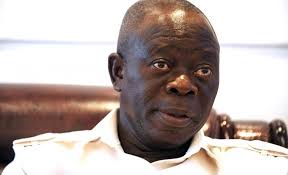
 Senator Adams Oshiomhole has recounted how an Italian ambassador told him that Italian men could not resist Edo women, during a discussion on efforts to tackle human trafficking in Nigeria.
Oshiomhole made the disclosure during plenary on Tuesday while discussing the need for the Nigerian and Italian governments to address both the demand for and supply of victims of human trafficking.
The former Edo State governor said he had met with the Speaker of the Italian Parliament, who promised technical assistance to Edo State in addressing the supply side of human trafficking.
According to Oshiomhole, he told the Italian official that the Italian government should also work to discourage its citizens from patronising trafficked women.
He said, “I know I met with the Speaker of the Italian Parliament, who said he was going to give Edo some technical assistance to deal with the issue of supply, and I told her that in history we don’t demand the supply.
“So the Italian government should do whatever they can to discourage their men or others, because these people didn’t go through Libya. They went through the Italian embassy.”
Oshiomhole said he argued that Edo State and Akwa Ibom State could address the supply side if the Italian government tackled demand.
“The law of economics is that without demand, there will be no supply, but when demand is strong, supply will find its way. So I think this really is a national problem,” he said.
He further recounted that when he asked the Italian ambassador to address the demand side, the ambassador replied, “Your Excellency, I’m sorry, Italian people cannot resist Edo girls.”
Oshiomhole said he responded by insisting that Italian men needed reorientation rather than placing the responsibility solely on Nigerian communities.
“If they cannot resist, they need the reorientation. Let them deal with Italian people and not Edo people,” he said.
He added that he would only focus on addressing the supply side if there was evidence that the demand side was also being tackled, warning that Nigeria should not be viewed internationally as a country involved in human trafficking.
The senator also called for action against organised groups in foreign countries that he said supported the trafficking of Nigerian women.
During the discussion, Senate President Godswill Akpabio asked Oshiomhole whether he had tried to find out what the Italians found in Edo women.
“Seriously, just for the benefit of my colleagues, did you try to find out what the Italians found in the Edo girls?” Akpabio asked.
Oshiomhole replied, “I couldn’t do that because I’m a Catholic and I’m happily married.”
Akpabio subsequently spoke about legal measures to combat kidnapping and related offences, recalling that he had signed a law prescribing the death penalty for kidnapping when he was governor of Akwa Ibom State.
He said the law also provided for the forfeiture and demolition of properties used in kidnapping, adding that such measures could serve as a deterrent.
The Senate President called for stronger enforcement of existing laws and better rehabilitation frameworks for trafficking victims returning to Nigeria.
He also referred to the need to review relevant legislation, including the Trafficking in Persons (Prohibition) Enforcement and Administration Act, 2015, and the Child Rights Act, 2003.
The Senate subsequently adopted the recommendation to strengthen existing anti-trafficking laws through more effective enforcement and rehabilitation measures.
